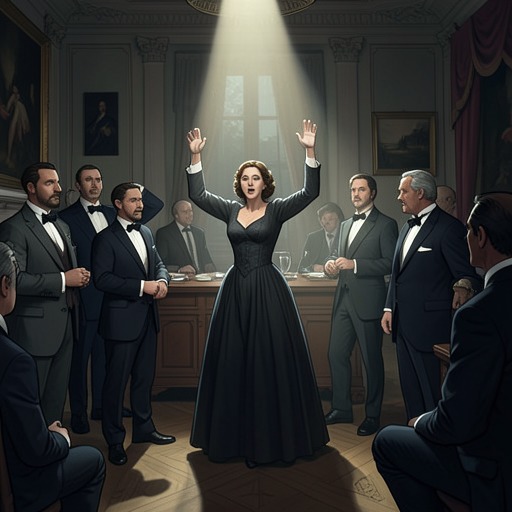
Capture of the Sea Monsters
The Moon and the SunThe capture of the sea monsters enters the narrative less as a staged hunt than as an event whose consequences reorganize life at court. Louis XIV turns the capture into the subject of a commissioned cantata, while the captured creatures occupy two sharply different roles: a dead body prepared for examination and a living sea monster whom Marie-Josèphe de la Croix is trying to train. The event links Yves de la Croix’s identity as a hunter to his sister’s artistic commission and her uneasy work with the captive creature.
The Capture as a Courtly Subject
Louis XIV commissions Marie-Josèphe to compose a cantata for his anniversary in memory of her father, then specifies that its subject should be the capture of the sea monster. He presents her as the fitting composer because she is the sister of the hunter, making the capture both a royal spectacle and a family matter. Marie-Josèphe accepts with apprehension, then determination; the King’s approval matters more to her than Pope Innocent’s irritation.
Pope Innocent objects that hunting is unsuitable for a Jesuit priest and composing is unsuitable for his sister. His response exposes the gendered and religious restrictions surrounding the commission, but it does not undo the King’s order. The capture is thus made into public court culture even as the authority of the Church contests who may hunt and who may compose.
The Dead Creature and the Dissection
At the Fountain of Apollo, preparations for examining a dead sea monster make the capture’s material cost visible. Before Louis XIV arrives, Marie-Josèphe draws aside the shroud from the carcass: it has been prepared for dissection, with part of its body exposed. She stands beside her drawing box and tries to attract as little attention as possible as the King is brought into the tent with Yves de la Croix and Lucien de Barenton, Count de Chrétien.
Louis XIV says that the creature’s internal organs should be examined in private. That decision sets the dissection apart from the public attention gathering outside, where the fountains are running and visitors stream toward the tent. The captured sea monster is at once a royal possession, a subject of inquiry, and a body whose examination the King controls.
Marie-Josèphe and the Living Captive
The account contrasts the prepared carcass with the living sea monster Marie-Josèphe is training. In private reflection, she hopes that, given a few days, she can teach the creature to remain silent when Louis XIV next sees it. But delay carries its own cost: the dead male sea monster may decompose before the dissection, making her training efforts seem futile. Her objectives are therefore divided between influencing the King’s encounter with the living creature and preserving the opportunity to study the dead one.
During the public gathering, Marie-Josèphe worries that the living sea monster will be hungry because a servant has not yet brought the fish. She has already induced the creature to eat from her hand, and she rubs her sore wrist while wondering whether hunger might make it more likely to obey her. Her approach combines care with an attempt to manage the captive’s behavior; the scene does not settle that tension, but makes it central to her relationship with the animal.
Consequences and Significance
The capture supplies Louis XIV with a subject for ceremonial music and an object for private examination, while Marie-Josèphe’s work introduces a different possibility: sustained contact with a living captive. The contrast between the dead male body and the sea monster she feeds and trains gives the event two divergent continuations, dissection and attempted communication. The capture’s significance lies in this division: the creatures are claimed by royal power and natural inquiry, but Marie-Josèphe’s efforts also make their captivity a relationship she must negotiate rather than merely observe.